About Us
Better Water. Backed by Real Confidence.
At One Water Australia, we believe your water should never come with uncertainty. It should come with clarity. With confidence. And with a team that stands fully behind what it delivers. That’s why everything we do is built around one simple principle: If it’s not right for you, it’s not right for us.
WHY ONE WATER EXISTS
We started OneWater after seeing too many Australians left uncertain, pushed toward products they didn't fully understand, given jargon instead of answers, and left wondering if they'd made the right call.
We believe the decision to filter your water should feel calm and informed. Not rushed, confusing or like you've been sold something.
So we built a business around a different approach: start with understanding, recommend what's right, and stay accountable long after installation day.
PART OF ONE GROUP AUSTRALIA
OneWater Australia is part of OneGroup Australia. With Australians owned brands like OneSolar Australia, OneProperty Australia, and OneFinance Australia under the umbrella, we share the same operating principles across the group
- Long-term outcomes over short-term wins
- Transparency over pressure
- End-to-end delivery without cutting corners
When you deal with OneWater, you're dealing with an accountable organisation.
PROUDLY WATERMARK CERTIFIED
WaterMark certification is an Australian standard that ensures plumbing and water products meet strict safety and quality requirements. Our systems are certified products, tested to comply with national regulations and are safe for use with drinking water systems. In short, it’s a mark of compliance, safety, and trust.

HOW WE WORK
We start with a simple conversation and take the time to understand your home, your water, and what matters most to you, without overcomplicating things.
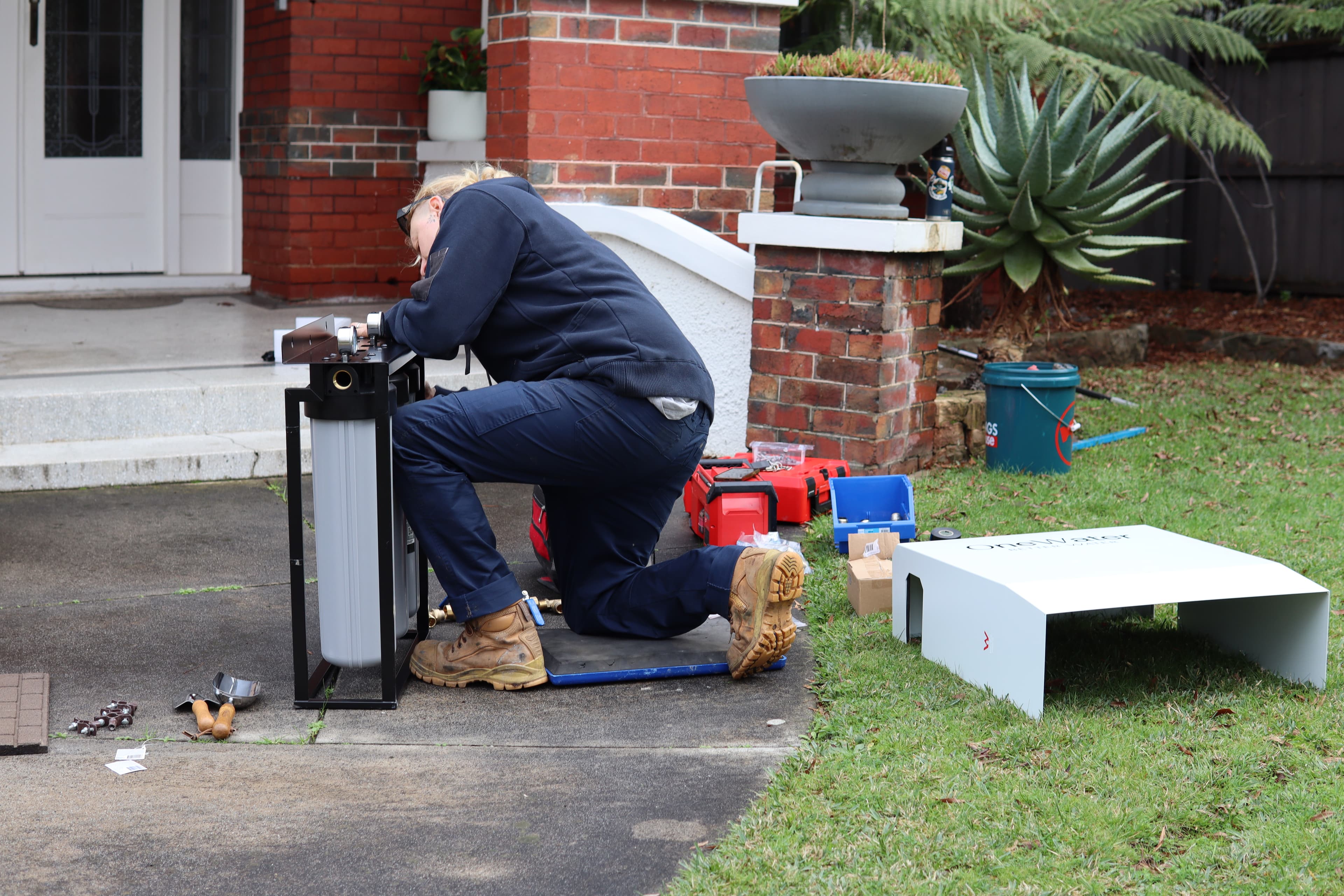
From there, we design a tailored water filtration system and guide you through installation, setup, and ongoing support - we don’t install and disappear! The result is better water throughout your home, with a process that feels clear, with ongoing support.
OUR COMMITMENT
We're committed to honest advice and transparent recommendations, even when that means suggesting a simpler solution than you expected.
If you choose to work with OneWater, you'll have a team invested in your water quality long after installation day.
In short, we're here to help you make a confident decision at your pace.
CURIOUS ABOUT YOUR WATER? LET’S CHAT.
Speak to a Specialist and we’ll come to you. No obligation.
Just a clear, honest picture of what’s in your water and what you might want to do about it.
Why choose OneWater Australia?
Customers choose OneWater because we offer:
- Clear explanations without pressure
- End-to-end service from one experienced team
- Systems designed for Australian conditions
- Ongoing support beyond installation
We focus on helping you make the right decision for your home, not a rushed one.
What's the best next step?
If you're curious about your water and want clear answers, the best next step is a conversation.
Speak to a Specialist
No obligation. No pressure. Just expert guidance you can trust.
How much does a whole house water filter cost?
OneWater's whole-home systems start from $27/week on a flexible fortnightly payment plan, with no large upfront cost. See our full cost breakdown for hardware, installation and running costs.
How much does whole home water filtration cost to install?
Installation cost depends on your property, but typically ranges between $700 and $1,000 AUD. We bundle this into the $27/week plan. This covers both labour and all hardware components — copper, ball valves and fittings included. Most installations take around three hours. It's worth mentioning that some properties are more involved. Access to the water main can occasionally require excavation, which affects the time and cost. That's exactly why we send a team member to inspect your property before you commit to anything — it lets us assess serviceability on site and give you an accurate, no-surprises quote upfront.
Do I need a licensed plumber to install a whole house water filter?
Yes. You can either have OneWater's team install it for you, or have your system shipped with full instructions for a licensed plumber to fit. This keeps the install safe, compliant with plumbing codes, and keeps your warranty valid - it can't be fitted by an unlicensed person.
Do you install whole house water filters across Melbourne?
Yes. We install in Melbourne. You can either have OneWater's team install it for you, or have your system shipped with full instructions for a licensed plumber to fit. This keeps the install safe, compliant with plumbing codes, and keeps your warranty valid - it can't be fitted by an unlicensed person.
Do you install whole house water filters across Gold Coast?
Yes. We install in Gold Coast. You can either have OneWater's team install it for you, or have your system shipped with full instructions for a licensed plumber to fit. This keeps the install safe, compliant with plumbing codes, and keeps your warranty valid - it can't be fitted by an unlicensed person.
Do you install whole house water filters across Brisbane?
Yes. We install in Brisbane. You can either have OneWater's team install it for you, or have your system shipped with full instructions for a licensed plumber to fit. This keeps the install safe, compliant with plumbing codes, and keeps your warranty valid - it can't be fitted by an unlicensed person.
Do you install whole house water filters across Sydney?
Yes. We install in Sydney. You can either have OneWater's team install it for you, or have your system shipped with full instructions for a licensed plumber to fit. This keeps the install safe, compliant with plumbing codes, and keeps your warranty valid - it can't be fitted by an unlicensed person.
Do I need a whole house water filter?
If your water tastes or smells of chlorine, leaves spots on glass and benchtops, or you're concerned about contaminants like PFAS or microplastics, a whole house filter treats every tap at the point water enters your home - not just the kitchen sink.
Is a whole house water filter worth it?
For most households, yes. It removes chlorine taste, smell and skin irritation at every outlet, not just the kitchen tap, and protects appliances and fixtures from limescale buildup over time. The main trade-off is upfront cost versus a basic under-sink filter, which only treats drinking water.
What's the difference between a whole house filter and an under-sink filter (like from Bunnings)?
An under-sink filter only treats water at one tap, usually the kitchen sink - it won't help with chlorine in your shower, laundry, or any other outlet. A whole house system treats water once, at the point it enters your home, so every tap benefits. Under-sink filters are cheaper upfront but narrower in what they actually cover.
How does a whole house water filter work?
It's installed at your water main, so all water is filtered the moment it enters your home before it reaches any tap, shower, or appliance - rather than filtering water at each fixture individually.
How does a reverse osmosis water filter work?
Reverse osmosis forces water through a semi-permeable membrane with pores just 0.0001 micron across — finer than bacteria and finer than most viruses — blocking contaminants, dissolved solids and many chemical compounds while letting water molecules through. Our under-sink RO system tucks neatly out of sight inside the cabinet and connects to its own dedicated tap at the sink, so filtered water is always on hand for drinking and cooking without taking up bench space. Because the system does the work quietly in the background, all you notice is cleaner, clearer water every time you pour.
How does a water softener work?
A true water softener removes the calcium and magnesium minerals responsible for "hard water" through a process called ion exchange, where the water passes through a resin bed that swaps those minerals out. Because the resin needs to be periodically flushed with salt to keep working, a dedicated softener includes an electrical component to manage that cycle — which is what sets it apart from a standard filtration system.
Our whole-home system reduces hardness minerals as part of its filtration — around 50% of calcium and 50–60% of magnesium — which helps cut back on limescale buildup on appliances, fixtures and glassware. Our reverse osmosis system goes further at the point of use, removing up to 98% of both.
For complete softening across every tap in the home, a dedicated softener system is the right tool. OneWater's standalone softener systems are coming by the end of the year.
Can filtered water help with skin and hair?
Many customers report that filtered water feels gentler on skin and hair, particularly during showers and baths. Reducing chlorine and other irritants can be beneficial, especially for sensitive skin.
Individual experiences vary, which is why expectations are discussed clearly during assessment.
Does filtered water taste different?
Yes. Many people notice an improvement in taste and smell after filtration, which often leads to drinking more water and reducing reliance on bottled water.
What happens during installation?
Installation is handled by our experienced team and typically involves:
- Preparing the system
- Integrating it into your existing plumbing
- Testing and commissioning
We explain what to expect beforehand and aim to minimise disruption to your home.
How long does installation take?
Installation time varies depending on the system and your home, but it's usually completed within a day. We'll confirm timing during your assessment.
Do I need to be home during installation?
Yes, someone will need to be home during installation. We coordinate timing with you to make the process as convenient as possible.
How long does a water filter last?
There are two parts to the answer: the cartridges inside the system, and the system itself.
The cartridges are consumables, designed to be replaced on a regular schedule as they do their work. For our whole-home system that's typically every 12 to 18 months depending on the stage, and for our under-sink RO system every 12 to 24 months, with the RO membrane lasting around two years. We have a dedicated page to re-purchasing your filters as part of ongoing servicing. The system itself is built to last and has a lifetime warranty.
How often should I replace my water filter cartridge?
Every 12–18 months. Based on your product spec and typical household usage. OneWater customers can order genuine replacement cartridges directly, or book a service with our licensed team.
How often should I change my whole-house water filter?
Most cartridges are changed every 6 to 18 months, depending on the stage. The Stage 1 sediment filter does the heaviest lifting, so it's recommended every 6 to 12 months, while the Stage 2 and 3 cartridges typically last 12 to 18 months. Where you land in that range comes down to your household size and water usage — busier homes simply run through cartridges a little faster. We track the schedule and handle changes as part of ongoing servicing, so you don't have to keep an eye on it yourself.
What does whole-house water filter maintenance involve?
Day to day, maintenance is straightforward: it's mainly cartridge replacement on the recommended schedule, plus an occasional check to make sure everything's running as it should.
How hands-on you want to be is up to you. If you're comfortable doing it yourself, we deliver the right filters to your door — either as a discounted annual package or a two-year value pack — with a step-by-step guide so you can fit them in minutes.
If you'd rather not think about it, our CarePlan takes care of the lot. A technician comes to you once a year to replace every filter and carry out a full service, including a leak inspection, pressure check and sanitisation flush, with priority servicing and technician callouts included. No filters to track, no postage, nothing to fit yourself.
What are the pros and cons of a whole house water filter?
Pros: every tap is treated, reduced chlorine taste/smell and skin irritation, less limescale on appliances and fixtures over time. Cleaner safer water for your family home. Cons: higher upfront cost than a single under-sink filter, and it must be installed by a licensed plumber at your water main rather than a DIY swap.
How much water does a house use per day?
On average, household water consumption in Winter is 395 litres per day and 500 litres per day in Summer. We use on average 1.3 litres of water every time we use a tap and, on average, 1000 litres of water is used every hour you water your garden.
How are your systems designed?
Our systems are designed specifically for Australian water conditions. They meet Australian standards and certification requirements and are selected based on suitability, not one-size-fits-all packages.
Are your systems compliant and certified?
Yes. All systems are specified to meet relevant Australian standards and certification requirements. Compliance is a non-negotiable part of how we operate.
Do I need to understand the technical details?
No. We explain everything in plain English and answer any questions you have. Technical detail is available for those who want it, but you never need to become an expert to feel confident in your decision.
Do water filters remove chlorine?
Yes - chlorine is one of the most common things whole house filters are designed to reduce, since it's typically what causes tap water to taste or smell "off," and can dry out skin and hair with repeated shower exposure.
How do I remove chlorine from my shower water?
A whole house filter treats chlorine at the point it enters your home, so your shower water is filtered along with every other tap - rather than needing a separate shower-head filter.
Does reverse osmosis remove PFAS?
PFAS are often called "forever chemicals" because they don't easily break down in the environment. They've been detected in some Australian water supplies, particularly near industrial sites, airports and firefighting training areas. While these supplies are regulated, many households prefer to reduce their long-term exposure where they can.
Reverse osmosis is one of the most effective methods for reducing PFAS, because the membrane is fine enough to block many of these compounds. Depending on the system, our filtration is also designed to reduce a range of other contaminants — including trihalomethanes (THMs), chloroform, PAHs, herbicides, insecticides, and traces of pharmaceuticals and hormones.
Reduction rates vary by contaminant and by system, so rather than make blanket claims, we're happy to share our laboratory specifications, which set out exactly what each system removes and to what level. Get in touch and we'll send them through.
How do I remove PFAS from my water?
The short answer: it takes advanced filtration, not standard treatment.
Conventional municipal water treatment — the coagulation, sedimentation and disinfection most supplies go through — removes very little PFAS, often less than 10%. Meaningfully reducing these "forever chemicals" requires specific technologies designed for the job: reverse osmosis, nanofiltration, or activated carbon (and ion-exchange resins) rated for PFAS.
That's where a point-of-entry or point-of-use system comes in. By adding the right filtration stage before water reaches your tap, our systems are designed to reduce PFAS that standard treatment leaves behind. How much comes down to the specific compound and the system — smaller PFAS molecules are harder to capture than larger ones, and local water characteristics play a part too.
Because reduction rates vary, we don't make blanket claims. Instead, we're happy to share our laboratory specifications, which set out exactly what each system removes and to what level. Get in touch and we'll send them through.
Is PFAS in Australian tap water?
PFAS has been detected in some water supplies across Australia, though levels and regulation vary by state and water authority. There is pretty daming evidence reported through ABS that types of PFAS were detected in the blood of over 85 per cent of the Australian population, while six types were detected in less than 10 per cent of people.
What are "forever chemicals" and should I be worried about them?
PFAS — often called "forever chemicals" — are a group of manufactured compounds that don't break down naturally in the environment. They've historically been used in everyday products like non-stick coatings, waterproof textiles, food packaging and firefighting foams. Because they're highly resistant to heat, chemical and biological breakdown, they tend to persist in the environment and slip through most standard water and wastewater treatment processes.
Long-term exposure to certain PFAS has been linked to a range of health concerns, which is why many households prefer to reduce their exposure where they can. Filtration at the point of entry is one practical way to lower the amount of PFAS reaching your household's water. Reverse Osmosis is also effective in PFAS removal and is especially benefical for minimising risk via consumption.
Is PFAS in Australian tap water?
PFAS has been detected in some water supplies across Australia, though levels and regulation vary by state and water authority. There is pretty daming evidence reported through ABS that types of PFAS were detected in the blood of over 85 per cent of the Australian population, while six types were detected in less than 10 per cent of people.
Research into long-term health impacts is ongoing, but many households choose filtration as a precautionary measure to reduce potential ingestion.
Do water filters remove microplastics?
Yes — filtration with a fine enough physical barrier can reduce microplastic particles. Systems that combine activated carbon with sediment filtration, or use reverse osmosis, are able to capture particles down to a very small size. Reverse osmosis in particular works at 0.0001 micron, far finer than the microplastics typically found in tap water.
Because reduction rates vary, we don't make blanket claims. Instead, we're happy to share our laboratory specifications, which set out exactly what each system removes and to what level. Get in touch and we'll send them through.
How do I remove microplastics from my water?
The same point-of-entry filtration that addresses chlorine and PFAS typically also captures larger microplastic particles, depending on the filtration stage. Because reduction rates vary, we don't make blanket claims. Instead, we're happy to share our laboratory specifications, which set out exactly what each system removes and to what level. Get in touch and we'll send them through.
Why is there chlorine in my tap water?
Chlorine is commonly added to disinfect drinking water and prevent harmful bacteria. It's effective for treatment, but it can also:
- Affect taste and smell
- Contribute to dry or irritated skin and hair
- React with organic matter in water to form by-products
Many households choose filtration to reduce chlorine while still keeping their water safe and treated.
Should I filter fluoride out of my water?
Fluoride is added to drinking water in many parts of Australia to support dental health.
Some households prefer to reduce fluoride intake due to personal health preferences, sensitivities, or dietary considerations. Others are comfortable with it and choose not to.
Filtration is about choice. We explain options clearly so you can decide what's right for your home.
Can filtration reduce heavy metals in my water?
Yes. Heavy metals such as lead, copper or aluminium can enter water through:
- Older plumbing and pipes
- Fixtures and fittings
- Local infrastructure
Even when municipal water meets standards, metals can be introduced between the street and your tap. Filtration can help reduce exposure, particularly in older homes.
What causes rust and sediment in my water?
Rust, sediment and particulate matter are often linked to:
- Ageing pipes
- Pipe repairs in the area
- Bore or regional water supplies
These particles can affect water clarity, taste and appliance longevity. Filtration helps remove visible and invisible particulates before they circulate through your home.
What causes limescale and hard water at home?
Hard water minerals can leave buildup on:
- Appliances
- Shower screens
- Kettles and coffee machines
It's not usually a health concern, but many households choose filtration to protect their appliances and cut down on ongoing maintenance.
Can water filters remove bacteria and microorganisms?
Municipal water supplies are generally well managed, but bacteria can become a concern in specific situations, such as:
- Tank or bore water
- After plumbing or infrastructure work
- Localised contamination events
The right filtration option depends on your water source and household needs, which is something we can talk through with you.
Why doesn't my water taste or smell right?
Sometimes the concern is simple — the water just doesn't taste or smell the way it should.
Seasonal changes, treatment adjustments and local conditions can all affect taste and odour. Filtration helps deliver more consistent, pleasant water quality year-round.
Do regional water supplies differ?
Yes. City, regional, bore, and tank water can vary significantly.
There's no one-size-fits-all solution, which is why we start with understanding your specific water supply before making recommendations.
What is whole-home water filtration?
A whole-home system treats water at the point it enters your home, delivering filtered water to every tap, including bathrooms, laundry, and kitchen.
Will filtration reduce water pressure?
When properly specified and installed, whole-home systems should not noticeably reduce water pressure. Our systems are designed for Australian homes and assessed against your plumbing and usage needs.